
Breakthroughs in Brain Health
DRAFT CASE FOR SUPPORT
AT A GLANCE
UC Davis researchers are working to develop safe, personalized treatments for neurological injuries and conditions like depression, PTSD, addiction and Alzheimer’s disease.
KEY ACTIVITIES
- Fuel novel, high-reward research
- Pursue mechanistic studies and human trials of potential neurotherapeutics
- Develop lasting treatments for nervous system health
INITIATIVE LEADERSHIP
- David Olson, Professor of Chemistry, Professor of Biochemistry and Molecular Medicine
- John Gray, Associate Professor of Neurology and of Psychiatry and Behavioral Sciences
- Manpreet Singh, Professor of Psychiatry and Behavioral Sciences
- Kim Barrett, Vice Dean for Research, School of Medicine
- Fernando Santana, Vice Dean for Basic Sciences, School of Medicine
ADMINISTRATIVE LEADS
- Susan Murin, Dean, School of Medicine
- Estella Atekwana, Dean, College of Letters & Science
TODAY
People living with conditions that affect the brain face some of the most serious, persistent health challenges — and some of the most difficult to manage.
Current treatments for major depression, for example, commonly lead to remission in just one-third of patients, while Alzheimer’s disease remains irreversible. Yet devastating psychiatric and neurological conditions are so prevalent that they affect nearly every family, in every part of the world, in some way.
Research has found that psychedelics like ketamine, ibogaine and lysergic acid diethylamide (LSD) are some of today’s most promising tools for repairing the dysfunctional structures and circuits associated with many neurological and psychiatric conditions. These substances and related compounds have shown incredible potential to promote neuroplasticity, or the growth of nerve cells and neural connections. They also have demonstrated remarkably lasting effects as neurotherapeutic treatments; however, the science that explains these results is still in early stages.
Just as advances in DNA sequencing transformed the medical possibilities for treating genetic diseases, deeper understanding of why psychoactive drugs promote the growth of neurons can lead to breakthroughs in how we address many conditions of the brain and nervous system.
UC Davis is leading the way in psychedelic research to identify key molecules and mechanisms that may unlock non-psychoactive, widely accessible treatments for myriad neurological conditions.
DEFINED BY UC DAVIS
- UC Davis faculty were the first to discover how psychedelics promote structural and functional changes in the brain to regenerate damaged neurons and restore neural connections.
- UC Davis has identified thousands of potential next-generation neurotherapeutics for study — the next step in advancing understanding of these compounds and their medicinal properties.
- Refining safe, widely accessible medicines that promote neuroplasticity could heal 1 billion people.
This work could lead to life-changing, low-risk medications for conditions like:
- Generalized anxiety disorders and post-traumatic stress disorder (PTSD)
- Neurodegeneration, Alzheimer’s disease and Parkinson’s disease
- Depression, including major depressive disorder (MDD) and treatment-resistant depression (TRD)
- Schizophrenia and bipolar disorder
- Substance use disorders
- Epilepsy and other seizure-related disorders
- Traumatic brain injury (TBI), spinal cord injury and stroke
- Chronic pain conditions
Imagine: Twenty years from now, rigorous research that explains how ketamine actually reshapes the brain could move us from today's doctor-supervised infusion treatments — administered during lengthy clinic visits, with significant hallucinogenic effects — to a take-at-home pill that safely prevents what was once known as treatment-resistant depression. Our goal is to create a future where long-term treatment may not even be needed to address many neurological conditions that are currently considered chronic.
But first, there are fundamental questions to answer.
Understanding how, why and where psychedelics affect people at molecular and structural levels is the next step in evolving today’s psychoactive drugs into safe, targeted medications for tomorrow.
TOMORROW
KEY FUNDING PRIORITIES
Visionary donors will be crucial partners in helping UC Davis make breakthroughs in neurotherapeutic science. The following philanthropic investments are most urgent for our progress in developing treatments for many common brain conditions:
PEOPLE AND PROGRAMMING | GOAL: $75,000,000
- Endow key faculty and staff positions that allow the UC Davis Institute for Psychedelics and Neurotherapeutics (IPN) to recruit and retain top talent, sustain core clinical operations, and accelerate research that other funding sources cannot. The IPN is UC Davis’ chief convener of university research projects focused on novel neurotherapeutics
- Support undergraduate, graduate and postdoctoral fellowships in IPN content areas to inspire the next generation of researchers
- Provide pilot grants that fund collaborations to access new frontiers of neurotherapeutic science
- Fund clinical trial programs, including participant recruitment activities, supply purchases and service contracts to keep research instruments functioning
FACILITIES, EQUIPMENT AND TECHNOLOGY | GOAL: $25,000,000
- Build research infrastructure to support innovative clinical trials of cutting-edge drugs that can lead to new treatment paradigms. This includes storage and refrigeration for controlled substances, cloud-computing resources, and equipment like an MRI/PET scanner, a Phenix high-content imager and a PheraSTAR microplate reader
- Renovate or expand key UC Davis Health facilities, like the Imaging Research Center and the Advanced Psychiatric Therapeutics Clinic, to increase the spaces capable of housing IPN clinical trial studies and related research
At UC Davis, we have a team like no other studying psychedelic-derived neurotherapeutics and pursuing lasting treatments for a vast array of brain-based conditions.
Our preclinical and clinical scientists collaborate in ways other neurotherapeutic research groups do not in order to fuel cross-disciplinary breakthroughs in biology, chemistry, medical physiology and more. For example, UC Davis researchers made the discovery that psychedelics from different chemical classes share the ability to promote neuroplasticity. In 2020, UC Davis scientists were the first in the world to separate a psychedelic’s neuroplastic effects from its psychoactive features with the goal to engineer a non-hallucinogenic compound with therapeutic potential. This was a critical advancement toward treatments that can reach broader patient populations, such as people with dementia or schizophrenia.
Private support will allow UC Davis to continue making discoveries that are possible nowhere else. Gifts to catalyze innovative research across lab and clinical environments will open new horizons in discovery and treatment that have the potential to redefine how we sustain neurological and mental health.
DEFINING THE PATH FORWARD
Academia, industry and public grantmakers all play important roles in drug development, often working in partnership to advance research and aspects of scientific understanding. However, longstanding federal restrictions on psychedelic research, combined with public misconceptions about the therapeutic potential of psychoactive drugs, have left this critical area underfunded for decades. As a result, resources to support high-impact psychedelic research are scarce.
Private support will provide the key combination of stability and flexibility that UC Davis researchers need to continue pushing the frontiers of neurotherapeutic discovery and care. Gifts to support our innovative research, distinguished faculty, and advanced clinical infrastructure will enable new heights of collaboration across disciplines and specialties — catalyzing mechanistic studies, biomarker discovery, and novel clinical trial designs to understand how emerging treatments work and which populations they are best suited to treat. With diverse clinical trial participants who reflect a wide range of social determinants of health, UC Davis will design human trials of novel neurotherapeutics that serve as global models for implementation.
By enabling innovative preclinical and clinical partnerships, accelerating novel, high-reward discovery, and catalyzing impacts across laboratory and patient settings at UC Davis and UC Davis Health, philanthropic investment can make a critical difference in the evolution of psychiatric and neurological medicine.
THE IDEAL PLACE TO ADVANCE NOVEL NEUROTHERAPEUTICS
UC Davis has built an unusually collaborative network spanning the full spectrum of translational research in neurotherapeutics, from basic science and preclinical studies to clinical trials and patient care. Indeed, the breadth of our expertise sets us apart from any comparable university research lab. From the Department of Chemistry in Davis to the School of Medicine in Sacramento, UC Davis scientists and clinicians are poised to advance every aspect of research into potentially transformative treatments.
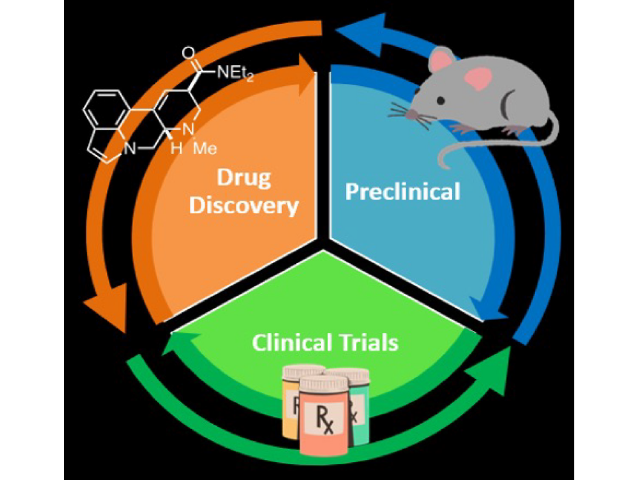
neurotherapeutic research within one institution.
The scientific environment at UC Davis is uniquely suited to foster neurotherapeutic research, with the facilities and expertise necessary to interrogate the full spectrum of the science of psychedelics, from molecules to circuits to human clinical trials. Our faculty are experienced in securing DEA Schedule 1 research licenses, have the ability to engineer novel analogs of psychedelics, and can launch key studies of real-world efficacy through UC Davis Health.
DEFINING ASSETS
- UC Davis has the only university research program covering all aspects of psychedelic science, including medicinal chemistry, preclinical testing and human studies.
- Our large interdisciplinary research portfolio in neurotherapeutics builds on pathbreaking UC Davis drug discoveries.
- UC Davis physician-scientists have unique clinical trial expertise and plan to launch innovative human trials of novel neurotherapeutics.
DEFINED BY UC DAVIS, REFINED WITH YOU
With private support, the extent of neurotherapeutic innovation that UC Davis can pursue is limitless. Philanthropic partnership can be the catalyst for breakthroughs that lead medical science toward safe, scalable, novel avenues for promoting brain repair and resilience. These innovations will have widespread, life-changing impacts that bring hope and healing to patients around the world.
Thank you for taking the time to review this early summary of our case for support. Your engagement as a volunteer and advocate for the university is indispensable as we refine a vision that is compelling, clear and inspiring. We welcome your candid feedback and invite your questions.